
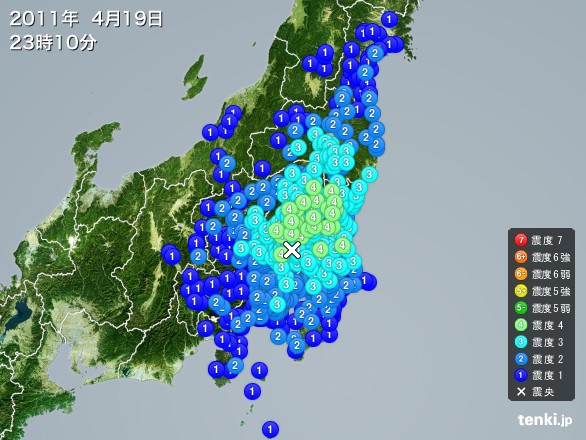
This is a shake map from the most recent quake felt around here, provided ( hope they don’t mind) by the awesome Tenki.jp. There’s a big X at the epicenter (this one was 50km deep, which is good), and the rest of the circles indicate how strongly the ground shook at particular points. This was a Mag 5.0, and the scale used (all the 4s and 3s in tinted circles) is the Japanese Shindo scale, a purely subjective assessment of how it felt at a particular point. By the way, I live just about where the southernmost teal “3” circle is.
Recent earthquakes indicate trouble on a different plate boundary, threat to Tokyo of expected "Great Kanto" quake.
The massive 9.0 “Tohoku” quake of 11 Mar was on an uncomplicated stretch of a subduction zone: the Pacific floor is shoving its way underneath Japan from the east. Further south, however, things get complicated indeed where the Pacific plate (PAC) is pushing under not only the plate Japan rides, but also the Philippine Sea plate (PSP), which is also pushing under Japan from the south (those of you who know more about this, let me get away with saying that, just to keep things simple and not go into relative motion).
This means that the silt bed beneath Tokyo is on a piece of crust which belongs to Japan proper, which has beneath it the PSP diving deeper as it goes north, and below that is the PAC, diving much deeper as it goes west.
Recent observations seem to indicate that either the PSP is diving at a different angle than was thought only five years ago, or that there is a chunk of the PAC lodged above the PSP, directly underneath Tokyo.
The real hazard to Tokyo is not the alarming and possibly destructive quakes which happen between plates in its own basement, but from just off the coast to the south, where massive slips occur, causing the population centers around Tokyo Bay to lurch in a similar fashion to the recent disaster up north.
From here, I offer my speculations.
The likely epicenter of the anticipated “Great Kanto Earthquake of 20xx” is very close to shore either in shallow water or in the Sagami trough, which while not as deep as the Japan Trench off Tohoku, could still generate a sizeable tsunami. If there is no tsunami, that would be because the quake is close enough to land that the shaking is experienced far more directly than was the case in Tohoku, and with only a few half-seconds of warning. If there is a tsunami, there would be less advance warning from quake to arrival time, due to proximity. The effects on major population centers might be mitigated by the natural defenses offered by the approaches to Tokyo Bay, which break up all but the largest of tsunamis and storm surges.
A large enough tsunami, however, would be experienced not a a rushing wall of water, but an irresistably rising level of water, which would simply fill the bay up and cause it to slosh through downtown Tokyo with enough just plain momentum to smash buildings and carry them for miles. It would not have to begin violently for there to be great violence in the flow once it is established, as we saw in Tohoku.
On the other hand, the tsunami need not ruin the inner reaches of the bay where it meets the Tokyo megalopolis to do real harm: in Kurihama, a few kilometers from my home, and with a spectacular view of the open Pacific Ocean, sits a nuclear fuel processing plant.

Are folks speculating on their long term prospects? I can’t help but be reminded of how after Katrina, there was some stream of consciousness speculating: should N.O. even be rebuilt/resettled?
How bad is worst case? Thousands perish and vast $$$ damage or a total collapse of an industrialized uber modern nation into . . . ?
[question may be treated at rhetorical]