
No, not that sort of graphic. This is a family site. I mean using graphics in our text, pictures in our words.
I frequently add graphics to my posts to literally illustrate a point, or provide an ironic counterpoint, or for (say) cheap laughs. There is a great infrastructure to prevent this uncredited and unpaid use of another’s creative effort and execution. This eventually will change. Why? It is elementary, my dear Watson. That which cannot endure will end.
The use of the “Watson” quote above is uncontested — it serves to encapsulate more than the bare meaning of the words, but to provide connotation by dragging along context from another environment. We do this all the time with words, and in our new medium, we will do it with graphics as well.
Publishing and copyright are a poor model for some of what happens in an online, graphical field of discourse. We may all lament the illiterization of our consumer goods as words are replaced with indecipherable blasted icons — why can’t the frigging thing just say “Power”? This is the new evolving language, and all the reactionary conservatism in the world will not save our old one. Homer is dead not because he is no longer assigned, but because we are no longer literate in his context.
Good artists borrow and great artists steal. The punishment for half-assing things is ignominy, which in discourse is the only true death. Those loved or hated are alive and well. Ya gotta mount the woman, son. The difference between borrowing and stealing is an act of will either way; the assertion of ownership, or the bold execution which leaves ownership in no doubt.
CNN went to war and lost over a tweaked graphic. That video clip will live on not as a clip of wrasslin, nor of Trump goofing off, but of CNN getting beaten down. If a picture is worth a thousand words, then there’s some math we can do. Some other day. Suffice it to say that the costs of search, storage, and transmission are now vanishingly small compared to the value of the time it takes to write a thousand words and to read them. Illiterate peasants can enjoy a good joke in a graphic format, and can frequently catch the first level of a referent-dependent snide remark if it is posted as a “meme”.
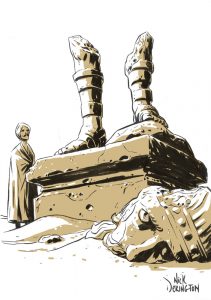 Webbing is the new speech, and pictures are the new words. Copyright law based on a publishing model will be worn away not through legal precedent or the reasoning of scholars, but through the sheer weight of failure to adequately address the needs of a changing reality. Someday when we all speak by “picting” images above our shoulders, this will seem obvious.

I often wish we could get some money into the pockets of the creators. They deserve it. I also think their should be a bunch of free stuff donated by people to further communication. Podcasts and blogs fall into this category for the most part.
All of those tools exist. Knock yourself out. I’ll be stealing. That is to say, quoting, in the new world.
dang. i thought this was going to be a post on how to post pics in comments.
*
We are dealing with an emerging post literacy where abstract thought capacity is intentionally diminished.
I welcome the use of images, but the ability to create concepts never seen before or understand abstractions of others may be hindered.
Words are the algorithms of the human computer.
I would disagree. I think the human computer likes images and words are the way we communicate those images. I didn’t used to think this but a book on memory techniques help me to see differently.
Maybe images and words cannot be divided. Words come from images and words bring images. If one notices advertising knows how to get people to buy this way.